Tuesday, August 19, 2008

Call of the Sirens (Part VIII)

Our scene: A darkened patient room in a large urban teaching hospital. Not particularly nice but not grim, either. Think tan vinyl flooring and grey laminate counters, but cleanish. The time? Between 5 and 6 am. There is a human-shaped lump on the bed under the beige hospital bed spread, breathing rhythmically in a narcotic-induced sleep. A lone figure in pea-green scrubs and short medical student white coat, pockets bulging with assorted paraphernalia, stethoscope draped 'round the neck, silently creeps in, making no sound, holding her breath. In one fluid movement, she pops one end of the stethoscope into her ears and snakes the other end under the covers and onto the patient's upper abdomen (the 'epigastrium', for those who enjoy such jargon). Holding it there for a brief 3 seconds, she then withdraws from whence she comes, out the doorway, to join the other identically attired members of her surgical team, 6 in all, 2 with short med student coats, 4 with long housestaff coats (2 interns, 1 junior resident, 1 chief resident). In terse whisper, the interloper imparts the following, "No complaints. Dressing intact. Breath sounds clear. Cardiac--regular rate and rhythm, no murmurs. Bowel sounds present." One of the members of the team quickly scribbles her words into the patient's chart. Another scribbles some orders and puts it with the rest of the team's charts on the rolling chart rack. On to the next room, where the performance is repeated with little-to-no variation.

Thus are pre-rounds on the surgical team.

Heaven on a scalpel.

Rules:
  • Always round before the patient is awake and family members are present. Talking to patients and especially family, wastes time. The nurses can read your note and take care of all that touchy-feely bullshit.
  • Always have the lightest team member examine the patient, the better to creep in and out without waking anyone. (See above)
  • Placing the stethoscope in one place allows you to (theoretically) examine all 3 organ systems (lungs, heart, gut) without all that needless mucking about that internists are so fond of, placing their stethoscopes here and there around the torso.
  • All this stealth is vital for the team to have rounded on all the inpatients ahead of time in order to be in the operating room by 7 am sharp: gloved, gowned, scrubbed, surgical instruments in hand, attending pimping away. ("So. Dr Piffle. What is the order in which one encounters the vessels that supply the GI tract coming off the aorta, in descending order and is each anterior or posterior to their corresponding venous counterparts?" "Errrrrrrrrrrrrrr....")

Ah. The surgical rotation, where one learns the 4 cardinal universal rules of surgery:

  1. Trust no one.
  2. Eat when you can, sleep when you can, pee when you can.
  3. The esophagus is not your friend.
  4. Don't fuck with the pancreas.

Contrast these with the 4 rules of internal medicine, as told to me by a rather cool attending:

  1. Medicine is not a science, it is an art based on science.
  2. There are at least 2 ways to do everything.
  3. Every patient is an n=1.
  4. If you're not having fun, something's wrong.

Taking #4 up there: see, the thing about surgery, is that it is fucking fun and really simple. Not the surgeries themselves, but the approach to medicine. You are congratulated for the shortness of your notes and your ability to turf (transfer the care of) any patient who is not in need of surgery right now, to a non-surgical service. You don't have to waste time on all this differential diagnosis stuff. Who the hell cares why Mrs Jones is demented, all you care about is if Mrs Jones is a surgical candidate. If not, turf her.

Turf her good.

(An aside-- that's one thing that reallyreally bugs me about all these medical shows. See, there are strongly delineated lines between medicine and surgery, especially in a teaching hospital. Surgeons operate and do the post-operative (including the surgical intensive care unit) care. They do not have anything to do with medical issues. They don't manage the insulin. They do manage the pain meds. The patient with some sort of unknown fever, unless there's an obvious surgical source, would never be admitted to a surgical service. The patient would be admitted to medicine, perhaps with a surgical consult as to whether or not surgery might be indicated, but NEVER to a surgical team. Also? There are distinct surgical sub-specialities. Don't mix general surgery with orthopedics, ob/gyn, ENT, urology. They do not generally cross specialities. A general surgeon won't be operating on a deviated nasal septum. Nor will that surgeon be fixing a heart or doing neurosurgery. And vice versa. Pediatric surgeons generally don't operate on adults and vice versa. Got it? Rigidly defined roles. There are exceptions but they don't practice in large teaching hospitals.)

I also adored the surgeries, themselves. All that glamorous, sterile attire. The appropriate etiquette. How to scrub--start by cleaning under the fingernails with the enclosed nail pick, then lather up with the sponge side, then scrub 10 times each part of each finger, then the backs of the hands then the palms, rinse with the hands up, letting the water drip down the arms and not off the fingers. How to move through a sterile field. How to change positions with a colleague at the table-- the one closest to the head turns out of place, rotating back-to-back, and turning around again to face the table. How to stand--arms crossed, hands under armpits or hands held in front of the chest. Never below the waist. Below the waist is not part of the sterile field. Neither is the back nor above the shoulders. How to gown and glove oneself (although the surgical circulating nurses will often do the honors of assisting with the donning of gown and gloves) while maintaining sterility. One does NOT break the sterile field or one will find oneself in small pieces in several parking lot dumpsters.

How not to pee for hours and hours on end. Drinking fluids is to be carefully timed. It's OK to have some coffee up until, say 6 am, but not later, unless it's a short case. Some cases go 12-14 hours.

How to stand so as to try to diminish the pain in your legs, your back, your arms. How to ignore the hunger. The fatigue. How not to look weak. How to bond with your team.

That last one was key, I've no illusions. I adored surgery because of my team. The Chief Resident was an amazing woman who actually enjoyed teaching and let her students do lots. The Jr resident was a middle aged guy who had been a cardiothoracic surgeon in his Eastern European country before he immigrated and had to do all his training all over, again. So he was very happy to have the students do procedures. As he was so qualified, our team would sometimes have 2 suites going at once, with the Chief, an intern and a student in one room and the Jr resident with the other intern and student in the second room, the attending wandering about between the two and the lounge. What's not to love?

And so, why the hell didn't you become a surgeon, m'dear?

Ah. First, because I knew my personality, and while I loved it, I knew I didn't have the soul of a surgeon. I don't like crises. You can't get away from the crashing, life-and-death, what-the-hell-are-you-going-to-do-right-this-minute-Doctor-this-person-is-dying stuff, but it's so much more common in surgery. The tools I have as an internist are the drugs, the endotracheal tube and ventilator, the cardioversion paddles, the labs and scans and the consultants. Not quite in the same league as what the surgeon faces with someone who's bleeding out.

Also, most surgeons are assholes. It's true. I've known lots of wonderful surgeons, but most are not. I'm not fond of assholes.

And finally, Charles would have divorced me, I'm sure. The residency is brutal, lasting 7-10 years for general surgery, depending on the program. Call is usually every other night. The off call days run 14-16 hours. It's the speciality that brought us the phrase "The problem with only being on call every other night is that you miss 1/2 the good cases." That in itself was enough to bring me to my senses and to make me an internist, with my drugs and scans and long, involved differential diagnoses. And to care why the hell Mrs. Jones was demented, because there are a few rare things that can cause reversible dementia and the surgeons sure as hell weren't going to look for them.

After my glorious weeks as part of the general surgical team, I headed off to my surgical elective, anesthesiology. Good god, what a shitty speciality. All fiddly deadly drugs and monitoring. The gas passers live a life, as the saying goes, of endless boredom punctuated by bits of sheer terror. As students, we were paired up with an anesthesia resident (no interns; anesthesia residents generally do a medical internship) with an attending overseeing. One attending in particular, the Chief of Anesthesia, enjoyed the reputation of being a remarkable jerk and was, for some inexplicable reason, heavily into professional wrestling. As students, we had to call the surgical patients we were to anesthetize the next day, the evening before, and go through all the questions they'd already been asked by the residents. The same EXACT questions. Which I thought was beyond bogus, especially, as we all know, I really don't like talking on the phone, especially cold calling strangers for no reason but to bother them on the night before their surgeries.

So I made it a rule not to call them.

Which, as luck would have it, came back to bite me in the ass the last day of the rotation, the biter being the dreaded professional-wrestling-besotted jerk attending. He asked me something that I would have known, had I called the patient (nothing vital to their care, don't worry, just something beside the issue). I said that I didn't know. He asked "Why not", bushy eyebrows descended to an alarming level. I said, "Because I didn't call." Seeming to swell to the size of a large grizzly bear, he thundered, "Why the hell not?" "Because I'm worthless and weak," I said matter-of-factly, looking him in the eye. I was exhausted and, I suspect, not averse to goading him into killing me and relieving me of my misery.

And then he laughed. And laughed and laughed and left for his standing date to watch Portland Wrestling. And he passed me with an acceptable grade.

Always tell the truth, dearest darlings, no matter what. You're likely to be caught in a lie at some point, and who knows, you might provide comic relief to someone. Plus, the truth is always simpler. Like surgery.

So that's how things ended with Diana and surgery, except I still get to wield the scalpel and suture from time to time in the office, with small things. And I still feel a bit whistful as I don the sterile gloves and ask my nurse to pass me the #11 blade.

But I make it a point to always say "please" and "thank you", just so no one thinks I'm a jerk.

Labels: ,

Thursday, August 07, 2008

What I've Learned On My Summer Vacation

I really don't know what I was thinking.

See, a few months ago, when there were still the remnants of all that winter snow in the mall parking lot, the kids were in raptures over one of those crappy little 'fairs' that were set up by the chain toy store. You know the sort: a small Ferris wheel, some sort of half-assed mini roller coaster, probably a tilt-a-whirl, a few win-a-.99-cent-prize by spending $5 and seeing if you can toss a ring around a bottle and some cotton candy and popcorn concessions.

Their pleas of "pleasepleaseplease" were answered with a 1-2 punch of "No!" and "We'll see about going to the big State Fair in the summer."

A trip to the fair in summer, being months away and warm and bright, seemed like just the ticket. Visions of tents pitched on the grass, breezes amidst the trees, parades of well-groomed cows and the like, accompanied by all sorts of fair food. What's not to like? Sort of a grown-up version of our small county fair that we went to a few years ago.

Oh, Stupid-o mio.

Concrete. Miles and miles of concrete overlayed with a cacophony of screaming. Unbelievably overpriced, with tens of thousands (hundreds of thousands?) of people scuffing along in the opposite direction of where ever it was we were trying to get to.

And to top it all off, I inflicted the whole thing on poor pal, Teri, who I've not seen in 2 years. "We're going to the fair! We'll be near you! Do you want to meet up with us and do the fair? We can get to spend some time together while the kids enjoy themselves."

Alas for her and her girls, meet us they did. The cranky, over-heated family who didn't bring enough cash for both riding and eating, or really even just riding. (Who the hell doesn't take credit cards these days, I ask you? That's not just unamerican, it's anti-commercial. Don't they watch TV? Life stops for those who taketh not the bits of plastic.) After a few hours of dragging around, we called it a day and packed it in, leaving poor Teri a little cotton candy colored puddle in front of the cursed Ferris wheel. (We'd gone back on purpose, right before leaving, so Colin could ride it, as promised, but he decided that he'd really rather not ride it after all and just.wanted.to.go.home.) As a topper, Sara succumbed about 1/10th of the way back to the car (conservatively a generous 1/2 mile (1 km) away, swimming like salmon up a stream of lemmings) and so Charles and I lugged her back, between us, Colin dragging behind.

Had we only stopped and indulged the lil' darlings all those months ago with the crappy parking lot fairlet, we'd have saved us all a bunch of woe, not to mention a chunk of change. Live and learn, cupcakes. Live and learn. Trade not the small pain of today for the large woe of tomorrow.

---------

A couple of weeks ago, though, I got to meet another of us, Teresa, out from Seattle to visit the relatives. We met up at the very large farmer's market around the Madison capital square and I got to sit and laugh with Teresa and her sister and daughter while her brother-in-law entertained her niece and nephew. It was, as it invariably is, an all-out gab fest as two people who've never met in person and yet know scads about each other's lives finally get to sit down and sip coffee and nibble baked goods. It's never long enough, is it? And what is Teresa like? Just like she looks: You have to hug her as soon as you see her. She absolutely sparkles. It should come as no surprise to know she teaches kindergarten. I don't know if only lovely people teach kindergarten or if teaching kindergarten makes people lovely. (I strongly suspect the former. 5-year-olds are sweet but I think were it me in a classroom of them I'd be heavily medicated or lobotomized and Teresa is neither.) I forgot my camera but she brought hers and posted one of us if you care to scoot over and wave "Hi" to her.
----------

And while we're on the topic of catching up over the past few weeks, what happened to The Pool? Well, it was replaced with a more modest and demure inflatable one that was used with reckless abandon by kids and dog, alike. When it was about to qualify for protected status under the umbrella of the endangered species act as a habitat for several newly emerging life forms, I emptied it, scrubbed it out and left it to desiccate a bit in the sun before filling it anew. Then one of those freak violent summer storms blew up out of nowhere. It ended up down at the bottom of the pasture impaled on something large and sharp, leaving it with a ragged rent in the side, rendering it no longer either "inflatable" or a "pool". Luckily, the pools are still on sale at an even more reduced price. I did toy with putting 5-6 of them in the cart. I think I will live to rue the day that I did not. I was wondering why Jocelyn was disparaging inflat-a-pools in her comment. Now I know.

Pictures for you

I'm just a-learning lessons left and right, aren't I?

-----------

Speaking of learning, I did finally take that agricultural medicine test last week. Not that anyone was really wondering, but take it I did. It was well and truly taken. Now I just need to wait for the results and then figure what the hell I'm going to do with all that newly gotten knowledge about tractor safety and the lot. Assuming I pass, of course. If not, then I guess I'll not need to decide. Win-win.

-----------

Interlude:

Here's the two fawns who seem to be growing and learning without their mum. They keep eyeing my vegetable garden but have decided that the tomatoes that have taken over most of the space aren't what they'd really rather eat. Aren't they pretty? I tried to post a larger, cropped picture but flickr wouldn't have any of it for some reason. Trust me. They're adorable and still have their spots.

Pictures for you

------------

Firmly entrenched in the heading of "When Will I Ever Learn" is finding that I have somehow agreed to serve my Network and can be found on the roster of the Physician Practice Committee. Gads. For almost 8 years I had successfully avoided such things but found myself thinking, "Hmm. This could be interesting and a way to make some positive changes in the good ol' firm. And breakfast will be served."

All this must have taken place right before lunch when my defenses and blood sugar were at a double ebb for I found myself responding that I'd be delighted to take a seat at that table. I now find that I've somehow become one of 2 physician leaders of the Patient Access sub-committee of the original committee. That's 2 committees. What were they thinking? What was I thinking? I'm the one who sits in the back and nods in agreement from time to time while eyeing the danishes and wondering if I can somehow snag another one while looking like I'm just stretching, sort of a variation on that old first-date-in-the-movie-theater move where his yawn ends with an arm around your shoulders. Now I'm to be at the head of the table at the horrible hour of 7 am, expected to contribute many things of worth AND I've not heard a word about food at these sub-committee meetings. I fear a large tumor has taken over the logic and reasoning bits of my frontal lobe. Here's hoping it rapidly eats away the rest of my higher functions and personality so I won't suffer too long. As an added bonus, we're to round up several other physicians to serve along with us. Ever try lining up docs to do such things? Forget herding cats. It's like herding birds. Birds who never return your calls. Can't say I blame them.

------------

And while we're on the subject, is there anyone else who would be horrified to find that the gown you were handed by the nurse for your daughter to change into at her kindergarten check-up/meet-her-new-doctor-now-that-your-insurance-has-changed appointment had 8 McDonald's characters spread across the front in various medical garb, all grinning horrifically?

I felt like putting posters of "Supersize Me" up all over the exam room. Good grief.

-----------

So, that's my hiatus in brief. Well, not really brief, actually.

I'll leave you (and you, Teresa as I promised you one, and you, Jocelyn, as you appreciate the inappropriate conversationalist that is the manic gardener, and you, Teri, as you are a true friend as you're still speaking to me despite the horror that was the state fair) with the following of my lovely tree lily. It topped out at over 6 ft (2 m) high and smelled of sweet, sweet summer. Don't look too closely as each cup was full of gorged and stupefied earwigs. The good with the bad, as is life.

Pictures for you

Hope the rest of you are well and you avoid state fairs and committee meetings.

(Oh, and if you happen to not look where you are vigorously weeding along your raised garden bed, and put your hand --gloved, thank god, but inadequately so-- in a hornet's nest, this will lead to a most painful stinging, causing a stream of fuckingshitfuckingshitsonofabitchFUC!KING!SHIT! to issue from your mouth as a reflex, and your small children will learn how to correctly pronounce, enunciate and vocally inflect those most taboo of words. They'll be the pride of the school playground in a few weeks.)

Labels: , , ,

Monday, July 14, 2008

Call of the Sirens (Part VII)

And so, we come back to our continuing saga of a goof attempting to become a physician. We've seen her go through the first two years of unrelenting butt work and are now in the spring of her discontented third year, having finished everything but pediatrics, something she already knew she didn't want anything to do with.

Which, of course, led her to just relax and have some fun and be told she should really go into pediatrics by lots of misguided people. But nonono. She knew better, she did. She could never see the tinytiny eardrums of those tinytiny infants, brought in by their terrified parents worried that they had ear infections. She also knew that she just couldn't take a life of constantly reassuring those worriedworried parents. But most of all, she knew if she went into peds, she'd have ended up in prison for having messily and publicly murdered the first person she came across to abuse a child. Either that or she'd have offed herself after the first time she made a mistake that endangered a child.

No. Peds it was not to be, fun as it was. She did learn how to give a good shot, though. How vaccinations would happen in the out patient clinic was someone would have a small child who needed several vaccines and the call would go out to all available nurses, nurse practitioners and me, the lone med stud. As soon as we had enough bodies, each armed with a syringe, we'd sidle on up to the tot, peacefully resting in the arms of a trusted adult. We'd each grab a limb, syringe firmly grasped in the other hand and, on the count of three, we would simultaneously stab the little angel, instantaneously transforming them into a howling, sobbing devil, complete with bright red complexion, banshee howls and visage of doom and destruction.

They said this was apparently less traumatic than giving each shot separately. Maybe they were right. I think there were studies quoted. There are always studies quoted in medical education. There seemed to be about the same amount of screaming this way as there was when my own two got their shots, one at a time, and there wasn't all the distressing repeat performance for the subsequent injections that happened with giving them in series.

The other thing I remember was that lunch and a show was provided each noon. Lunch was usually some sort of sandwich assortment and the show was usually something along the lines of "Pediatric Eczema and You" or "Meningococcemia: Know it. Fear it." Good times. The peds residents and attendings were also a happy, cheerful bunch, almost to a person.

I'm sure they were all heavily drugged or lobotomized. Perhaps both.

So that's that for the third year of med school. The rotation that was by far the most fun was the one I'd known from the start that I had no desire to pursue. I'm sure there's some sort of life lesson in that but I'm damned if I'm going to learn from it.

Now, the fourth year of med school is sort of like the third, but the rotations are usually smaller bites and you have to decide what the hell you want to go off and be an indentured servant for at the end of the year. You get to take ENT ("otorhinolaryngology" for those who crave big, multi-sylabic words) and learn to use the head mirror (that mirror thingy that olde-tyme docs wore strapped to their foreheads), which is actually really hard to use. At least it was for me. There's this trick to peering through the hole in the middle while focusing the light from the lamp across the room that reflects off the mirror and into the patient's throat, all while using an angled mirror (like the dentist uses) to see around the bend in the throat to examine the vocal chords, while NOT making the patient vomit all over you by inadvertantly bumping the back of their throat with the mirror. Of course, now-a-days, you'd just use a head lamp to see, or, even better, a fiberoptic laryngoscope, so you could actually see 'round the bend of the throat and not make everything thing up. ("Oh, yeah! I see it! That bitty nodule on the miniscule vocal chord. Really. I see it. Promise.")

You'd also do a week or two in ophthalmology (the eyeball guys), and get really skeezed out by all things horrible and eyebally. (The worst? The enucleation surgeries where they removed the whole damned eye for some sort of hellacious tumor or other. Heart rending and really gross. Yeah team.) Why the hell anyone would want to go into that was beyond me, but they did. It was a highly sought after residency. Blech. Two of my friends went into it. I'd always thought them sane, but I had to reconsider after that.

There was a week spent in the auditorium doing Law And Medicine, which scared the shit out of us. "YOU WILL BE SUED." "IT WILL BE HORRIBLE." "YOU WILL WANT TO KILL YOURSELF." "THIS IS NORMAL." "YOU WILL THEN TURN TO COPIOUS DRINK AND/OR DRUGS." "THIS WILL RESULT IN THE LOSS OF YOUR PRACTICE AND YOUR LICENCE AND YOUR FEW SHARDS OF SELF RESPECT." "HERE ARE SOME MORE CAUTIONARY TALES OF REAL PHYSICIANS, EACH ONCE A WONDERFUL, PROMISING PROFESSIONAL, NOW TO BE FOUND UNDER THE BURNSIDE BRIDGE WITH THE DISBARRED LAWYERS AND OTHER BUMS." Gah. "But don't let that bother you."

There were several electives, like dermatology (oozy and dull and all the rashes looked like all the other rashes) and ICU (terrifying but cool); and you also had to take neurology (oh, good GOD the damned neurologists and their 5+ hour attending rounds with nary a chair in sight; oh, how we all hated neurology with all their fiddly tests that never worked like the books said and their confounding and complicated tracts and cross-tracts. Like learning the wiring of an enormous 1910 house.)

And then, there was surgery. And the sirens called. Oh, yes they did.

But I am tired and there are children to be put to bed. So I will leave you here with images of eyeballs and rashes and a line of drooling, incontinent patients (and students) with horrible neurological diseases in your heads.

Because I'm not a pediatrician and, therefore, not nice like that.

Labels: ,

Wednesday, June 25, 2008

In Which She Inflicts Vacation Photos On All Of You

Pictures for you

So I'm back, sort of. Back in the sense that the bags are unpacked and put away, the wash is done, the house is in its usual state of disarray and the kitty has forgiven us for abandoning her. Actually, she seemed fine with the whole thing and looked rather horrified when we walked in the door all loud and stinky. She wore that look of "Oh. God. I thought you were coming back tomorrow. I thought I had another day to finish that season of My Name Is Earl."

Pictures for you

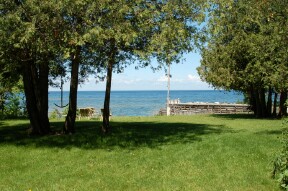
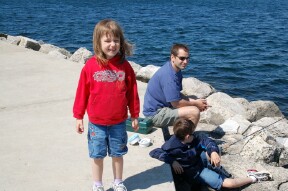
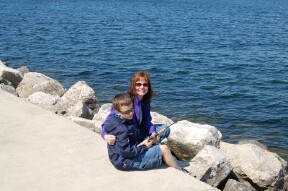
All told, we had 4 days in lovely Door County (that pointy bit of land at the NE end of Wisconsin that sticks in such a fragile way between Green Bay and Lake Michigan) and did little but eat, nap, hang out with each other and go fishin'. (Caught nothin' but a very small bullhead that looked really pissed off, but after all was said and done, was left with a belly full of worm and tales to tell of his abduction to the drowning atmosphere above the lake and the monsters that live there. I'm sure he'll get lots of use of that tale down at the fish pub where they'll buy him pints and await the tale of how he single-fin-edly beat up the 4 enormous aliens and then escaped back to the deeps with their sweet, wriggling food. Good for him.)

Pictures for you

We also taught Colin and Sara how to play Monopoly and how he who 1) buys up all the railroads and utilities and 2) doesn't get bored and quit after the first couple of hours tends to win. It's good to pass on such knowledge from one's own childhood to one's offspring.

Pictures for you

We did, indeed, go to a fish boil and ladled butter on fish, potatoes and onions. We ate many cherry-inspired products, like pie. And wine. And brought back lots of pancake and scone mixes. And jam and syrup and dried cherries. And wine. I also let Sara learn to take pictures with my camera, and so for the first time in 20 years,I have vacation photos with me in them because someone else was snapping the scenes as well.

Pictures for you

And so we all had a short, lovely, restful time, except for poor Molly-dog, who just thought the whole thing was wrong and WHAT the hell were we doing in this little house that smelled funny and had red tartan carpet in the kitchen and hall and WHAT would the kitty do with no one to chase her and give her a good butt licking. She clearly felt that it was all so wrong and couldn't understand why we didn't take her hint of staring hard at the car whenever we passed it, and just get in and go back home where we belonged.

It's always good to mess with your dog.

And so we've been and gone and returned and had our vacation.

The second half of the ag-med conference was as good as the first. I can now talk of ROPS and help you figure out what sort of respirator you need if you are cleaning out a silo, working in a CAFO or spraying your fields. I can also be found hollering from inside my car when driving past the fields and barns in my locale, "Hey! You! What the hell are you doing driving that tricycle tractor with the front end loaded!" and "Hey! You! I see you plowing that field in your cabless tractor without adequate hearing protection, sun screen, wide brimmed hat, respirator mask or ROPS!" In short, I've become even more of an embarrassment to polite society.

Pictures for you

Now I must get the contents of the 2" (5cm) syllabus and good-sized textbook into my squash, so I can pass the damn test and make my employer proud to have spent all that money (actually, in the scheme of things, it wasn't that much money as such things go) for me to have done this, which means that I'll still be blogging sporadically for weeks to come. That study time has to come from somewhere.

Charles is winding up his days as principal at his soon-to-be-old district. He drove to work today in the SUV to load up almost all his office-ly possessions and move them to the new digs. He starts next Tuesday, which means we have only one more day of driving in to work together. The end of an era.

And, so, I'll leave you with this year's before and after shots of the front flower beds. You'll notice that the 3 low-lying juniper bushes at the front of the bed have gone the way of Wanda and Muriel, last year's alien-abducted cinquefoil and have been replaced by about 20 pretty-pretty flowering lovelies. (Well, they will be flowering when it's their time to do so.) You'll also notice that I need to get busy and divide all the pretties that have cancer-like grown and taken over the garden, transforming it into something that looks like the Amazon jungle.

Pictures for you

Pictures for you

Labels: , , ,

Wednesday, May 28, 2008

In Which She Reports In And Goes Overboard With The Links

For most of us medico types, there is a love-hate relationship with zee conference. On the one butt cheek, there is the familiarity of sitting and have someone drone on and on about some esoteric disease topic. It's how we were raised, so to speak. Sort of like returning to the womb.


But on the other butt cheek, after the first several hours or after the first day if it is a very good conference, you realize why you were so very eager to get away from learning by lecture and so gleefully dived into trial by fire.


So, it was with a combination of up front eagerness and yet lurking tedium that I hopped in the car early Wednesday morning and headed south to the First Annual Agricultural Occupational Health Training Conference.


It's always good to go with a buddy to sit in the back with, eat meals with and make snide remarks to. I was fortunate to have at my side, C, one of the two nurse practitioners in the occupational med clinic that I am to lead at some point in the hopefully far-distant future. In addition to being a fun person to hang with (and a damn good practitioner), C had lived in Springfield, IL, where the conference was held and theoretically could co-pilot me through the roads with the help of the set of Internet directions, which feel that having the correct information 95% of the time will get you an "A".

We respectfully disagree and point out that substituting a "left" for a "right" will, in fact, lead one way the hell off in the wrong direction and get one rather hopelessly lost.

But, we made it, thanks to leaving extra-early, along with the other 30-40 of us, to the small building that is the administrative offices and classroom space of the School of Nursing for Southern Illinois University. As an added bonus, they served lunch before hand! As a special added bonus, the lunch was not only edible but really quite good, with brownies (very small but tasty) at the end. Charles and I often shake our heads over the difference between the fare of the education conference and the medical conference. I definitely chose the right field.

I settled in for the duration of the afternoon, prepared to enjoy the first 15 minutes of the novelty of sitting and having someone blither at me rather than being the one to blither for a change. And, damn, if the whole afternoon had me with my attention riveted to the speakers. I mean, really, hardly a daydream of wandering the shops or taking a nap. Unheard of. I mean honest-to-God, chin in hand, elbow on the table, eyes blinking less than usual, attention riveted on the speaker for the whole 2 +1/2 days. And the stuff I learned: The various risks of old vs new tractors (here's a hint--a covered cab WITH a roll-bar is a handy thing if you are fool enough to operate such a machine. Also--mowing the ditch with your beast of a tractor? Bad idea. They tend to roll over when used at a 45 degree angle (duh) and the odds of surviving a tractor rolling over on you? 25%. And your health benefits as a farmer? Oh, let's all laugh at your $10,000 deductible unless you're lucky enough to have a spouse with an outside job with insurance. ) And silos? "Silo" is the Russian word for "Certain Death Should You Venture Inside What With The Silo Gas And The Sucking Down Into The Grain Where Death Awaits You In Less Than 2 Minutes Plus Your Rotting Buried Corpse Won't Make The Grain More Nutritious For The Cattle And Will Be A Burden On Your Family So Don't Be A Stupid Git And Stay The Hell Out Of The Damn Thing". We won't mention the multiple deaths as a result in unsafe exposure to the manure pits under the CAFOs (Confined Animal Feeding Operations) where the hydrogen sulfide gas waits for you to succumb in 4 (yes 4) seconds and then pick off your buddies as they try one by one to rescue you. Bad that. No matter how you feel about such factory farming practices, I think we can all agree that it's best that the humans don't die, yes?

Oh, and the amputations and mutilations! 3 solid hours on this topic the second day, spanning lunch, with picture after picture, enlarged on the projection screen, of the most horrendous injuries and what to do. Oh, and the auger accidents. Seemed that 2 out of every 3 horrific injuries was due to the various damn augers catching a piece of clothing and pulling the human into the enormous machine. The lucky only lost body parts (which are sometimes re-attached, if not too mangled and are able to be retrieved and brought in with the rest of their owners within 4-6 hours). My favorite was the guy who lost 1/2 his hand (the distal 1/2 with all the fingers) that they fashioned a working limb with his two 2nd toes as transplanted digits that worked as a sort of a pincers so he could grip a bit with them.

I've the pictures in the syllabus. I've all the pictures in the syllabus. You know, just in case I need help with dieting some day.

And the Anabaptists? (The religious groups including the Amish, the Mennonites and the Brethren) Seems that while they don't have the tractor and auger injuries (as they don't have tractors and mechanized augers), they've got plenty of problems, what with being kicked and trammeled by the livestock they use in place of the wicked machinery, and, yes, the damn silos, and their natural distrust of modern anything. So that's what's up with the Anabaptists. Nice folk but leery.

And then! After the first 1/2 day, (which started out with us all going around the room and introducing ourselves, the horror!) we then all re-convened at a rather good bed-and-breakfast for no-bed-and-dinner and cocktails and appetizers and conversation and damn if we didn't come together and become friendly and start to chat together as acquaintances and not just isolated, anonymous strangers at a conference. C and I fell in with a nurse from Missouri and a Veterinarian from Illinois and ended up having dinner and walking around the town the next night together as well as walking the mile to the conference together the next morning, all gabbing like old friends.

They even had us all sign the official First Poster of the Red Barn AND had us all assemble for a group photo. As C said, "I think they'll be having us back for a 10 year reunion." It felt like that.

And it was good.

And it was so very interesting.

And we get to go to Part 2 in a few weeks.

And we can't bloody wait.

And why can't all the conferences be like this?

Labels: ,

Tuesday, May 06, 2008

Doin's

There's this back bathroom in our clinic, away down the end of the long physical therapy/chiropractor hall and around the corner past the tiny excuse of a break room. The advantage of that back bathroom is two-fold: First, it's away from a passing hallway, being at the bendy-end of the passageway, next to the emergency exit door (to be kept locked at all times on pain of hairy-eyeball of our practice director). It's a good place to go for some 'private time' with one's bowels, should the office coffee be a bit too much. It's also something of a game of Russian roulette with the toilet seat, as there's someone in the clinic who likes to anoint it and not dry it off. If you've a brain in your head, you check the seat every time before you place your cheeks upon it. If you've left your brain elsewhere as you nipped down the hall for a quick deposit, then approximately once a month you find your buttocks all wet and saddened as you've once again fallen prey to the scourge of toilet seats. (Fool me once, shame on you; fool me 43,892 times and counting, shame on me.) Actually, I don't think it's urine, I think it's water. God knows why someone would repetitively cover the seat with water and not wipe it off. I know who I suspect but it's not something you can just go up to someone about (especially this Someone) and demand that if they're going to wash the seat that they have the common decency to dry the damned thing off afterward (and while we're on it, why the hell are you washing the toilet seat?????).


Anyway, it's a small price to pay for privacy.


But the second reason to use the far-back bathroom is that a few times a year, there's a show. The bathroom abuts the outside wall of the clinic and about every 3 months during the non-frozen season, these tinytiny ants use the bathroom as their landfill.

It's fascinating.


I was thrilled to find that his week marked their spring return. Usually, their public works are partially hidden by the wastepaper basket in the corner, but this time it's been moved to the space between the sink and the toilet, so you can sit and watch the tinytiny ants tote them barges and lift them bales. Today, they were expelling grains of dirt, each the size of 1/2 their heads (the ants, themselves are about 2 mm long) and and! trying to get these two round white things (?? small donut sprinkles?? Who would eat a donut while using the crapper??) twice the size of their heads out of the bathroom and through the tinytiny crack between the vinyl baseboard and the floor and, presumably to their kitchen so they could dine upon them for dinner (it was past breakfast and lunch). 2-3 ants at a time would try over and over to get the sprinkle-balls through the crack, only to get stymied at the end and have the sprinkle balls shoot out of their grasp and pop back into the bathroom, flying about an inch (a whopping 25mm, such a vast ant-distance, just think) each time.


I have no idea what happened in the end, whether they finally found a wide enough crack or if 1 of the 3 workers said, "Fuck the rest of them, we've been doing all the work and we deserve a little tiny-sprinkle snack right here. Bob, Tina, grab a sprinkle and dig in." In any case, by the end of this afternoon, the ants and the tiny, white sprinkles were no where to be seen. Just small piles of tinytiny dirt grains at each break in the baseboard vinyl.


For some reason, they made me think of the manufacturing plant some of us went out to visit last week. 'Twere clean and well run as a factory goes but I was struck by the mind rotting tedium and the workers who didn't seem to mind their minds being rotted by the tedium. The plant pays well for standing and running a machine 8-12 hours a shift, 5-7 days a week (overtime pays well and most work at least 6 days a week). It was loud in many areas (ear plugs required), so no chatting possible. Many of the machines were fed every 10 minutes to every hour or so, and the rest of the time was spent staring and standing, perhaps tending another machine in the interim. The worst of the jobs (as seemed to me) were the 2 women chasing each other in a 6' (2m) circle as they moved small pieces of metal from station to station, washing and oiling and assembling the small parts for tractors and other heavy machines. Loud, dull, smelling of oil and metal. The lives of the ants seemed more full of interest. And these factory jobs, being both well paying and not requiring an education past high school, are in this town highly sought after and diminishing in number. I don't know what's worse: Having one of these jobs or wanting to have one of these jobs and losing it.


I am so lucky to love what I do and to find it endlessly fascinating.


Anyway, sadly, someone (the cleaning service?) will eventually notice Bob, Tina, Lou and the rest of the ant crew and spray neurotoxins and clean away the tiny grains of debris and all will be back to dull toileting, but until then, I'm only using that loo, wet butt be damned. There's worse jobs than being an ant.

Labels: , ,

Wednesday, April 30, 2008

Call of the Sirens (Part VI)

When last we left things, our heroine was poised to leap into her 3 month internal medicine rotation, in the dead of winter, having just come from the soul-leeching misery of ob/gyn. Her defenses, while never robust, were at an all-time low. As you all know, she did, indeed, end up bubbling in "Internal Medicine" on her computer Scan-tron sheet when it came to ranking residency programs and so it can be reasonably anticipated that this will be one excruciatingly long post, even for the wordy one. If you've anything better to do, feel free to use the down arrow to the right. She'll never know and you'll free up at least 30 minutes of your life that you'll otherwise never get back again.


(Oh, and if curious, here's a view of OHSU today. The skybridge to the right of center connects part of University Hospital to the blue Veteran's Hospital.)

----------
So, internal medicine it was to be. I don't think my stomach stopped churning the whole of the three months. The first half was spent, again, over at the University Hospital, this time on the cardiology service, which meant that we not only did regular general medical admissions, but also covered the Cardiac Care Unit and had double attending rounds.

Let's take a minute and discuss 'rounds'. Rounds are to medicine as dough is to bakers. There are endless varieties of rounds, some of which are truly endless. You start your day, if an underling, doing pre-rounds, usually about 6-7 am (5-6 am if on a surgical service). That's where you fly around to all the patients on your inpatient service and make sure they're all alive and nothing horrible, like a cardiac arrest or a transfer to the Intensive Care Unit happened over night, if you were not on call (and therefore theoretically left the hospital for a few hours to sleep and perhaps see something of a loved one or two). If you were on call, presumably you'd know all this and therefore would pre-round on those patients who were unstable or newly admitted over night to make sure they'd live a few hours more.

Then you'd go off to Morning Report. Here, one of the medical teams, usually the team that was going on call that day, would present a case that would then be discussed in depth, dissected, critiqued, and any blame assigned. Stressful, in a word. The presenting intern/resident/student was to be an expert on the patient and the condition being presented. All medical house staff, including the chief residents, and students assigned to the medical services were expected to be there, and it was usually attended by several of the attending physicians, including the Chief of Medicine. Many, many white coats packed into a small room.

After Morning Report, came work rounds, where you stomped around the wards and did the actual work for an hour or two. Work such as examining your patients, garnering lab and radiology reports, calling in consultants, writing chart notes, speaking to families, doing procedures, dictating admission, procedure or discharge notes, etc. New admissions from the night before, if transferred to your service because they were recently discharged by your service and re-admitted with a similar problem, like congestive heart failure exacerbation ('bounce backs'), were re-evaluated by the receiving team, patients discharged (hopefully to remain out of the hospital for the magic 2 weeks, so they were no longer under the 'bounce back umbrella'), and new admissions that came in during the morning to the day admission team were worked up. All this in just a couple of hours.

Later in the morning, or sometimes in the afternoon, were Attending Rounds. Each medical service (usually consisting of 1 resident, 2 interns and 2 students) had an attending physician, who was ultimately responsible for all the patients on the teaching service. During attending rounds, each patient was discussed and the plans were laid. All new patients were presented in depth, usually by the med student or the intern assigned to the case, and lots of pimping was done. Pimping is the time-honored tradition in which a senior medico asks questions designed to teach, instruct or downright humiliate the junior medicos, usually done in a group for maximum degradation. ("So! Dr Piffle! Give me the 5 mechanisms by which serum calcium may be elevated in multiple myeloma." "Ummmmm...Errrrrrrrrr...") Attending rounds were often done at the bedside and were particularly painful after the 24th hour of sleeplessness. (That's what you're seeing on a medical TV show when the whole damn team troops to the patient's bedside and one junior team member starts talking about the poor sick soul in front of them: "Mrs Muskox is a 67 year-old woman with a history of ovarian cancer who presented to the ER last night with a 6 week history of heavy vaginal bleeding and shortness of breath.") Often they go on for a couple of hours, minimum, except neurology attending rounds which usually went for 4-5 hours or surgical attending rounds, which were often less than 5 minutes, if they took place at all. If your feet are lucky, the attending is happy to conduct most of the rounds in the team office, in chairs. If not, you will rue wearing anything but the cushiest of shoes, and even they will be of little comfort after the second hour.

If you had time and there were no really-really sick people to attend to, you'd get to go to Noon Conference, with your actual non-cookie lunch, where someone would stand up (and not eat their own lunch) and yammer on for an hour about the renal tubular acidoses (Yes, I chose to talk for an hour on that very subject, once. Never again.) or the various treatments for esophageal varices or what-have-you. Usually, you'd sit there blissfully slack-jawed and zone out, letting the knowin' wash over and beyond you. If Noon Conference were presented by an attending known for pimping, you'd sometimes opt for plan B, which was to grab some lunch in the cafeteria and keep on working, because who the hell needs the stress of being pimped while eating? Often, however, if your team was on call, you'd have no choice but plan C, which was plan B without the lunch, unless you still had your cookie in your pocket, and then you hoped that you were eating your cookie lunch and not your cookie dinner, because breakfast was a long way in the uncertain future and the cafeteria closed by 7 pm. If you weren't on call, you'd go home sometime in the evening, prep for the next day by reading from your 20 lb (10 kg) tome of internal medicine, doing your many-page write-up, and memorizing every last thing you could for the next day's presentation during attending rounds in the vain attempt to look less shtoopid.

Typically, there were 4 medicine teams and so call rotated every 4th night, so in a typical 4 day rotation, you'd be in the hospital 60 hours out of every 84. Generally, as a student you'd get 3 days off a month and as an intern or resident, it'd be 1-2 days off a month. If your team were on call, then you didn't leave the hospital until the next evening, about 36 hours after entering the hospital. Depending on the dress policy of the hospital you were working in, at some point you'd change into scrubs, the better to slop around and be slopped on, and give yourself over to 'the zen of call', trying to just flow with it. Usually this would be short lived as you started to fold under an avalanche of admissions. It wasn't so bad as a student, as you'd usually concentrate on just one or two patients and tag along with the rest for the ride. As you didn't know as much as as, well, anyone else, including the housekeepers and the guy who filled the vending machines, you had to do a lot of looking things up in textbooks and journals (this was just before the internet was coming into use).

It is at this point that we must point out that our heroine was a less-than-impressive medical student. Filled to the brim with compassion and an interest in the subject of sick folk, she was a mousy, timid, oh-so-unimpressive lump of a thing. Presenting a case left me wanting a toilet in which to empty my gastric and colonic contents. As a result, one of the cardiology attendings I was under at the University Hospital (admittedly rather a jerk) told me at the end of his stint with me that I'd never make a good physician and I should just cut my losses and quit med school. I was mortified and crushed. And then I was pissed. What an asshole. To this day, seeing the combination of a man with slicked-back hair wearing a cashmere turtleneck with a camel hair blazer is enough to make me want to run over and hurl both insults and eggs at him.

And so ended that month and a half at The U, and it was time to change venues to the Veteran's Hospital, across the way. At that point the building was all shiny clean and new, having opened only a year or so prior. It was still a vast government bureaucracy, though, with everything done in triplicate and 4 patients per room. The nurses ruled the roost and if a task was not something specifically in their job description, the request was met with an icy stare and maybe a smirk. But! It was filled with the most spectacular patients ever. There were a few ancient WWI vets, all in their 90s. Many, many WWII and Korean War (oops, make that Korean Conflict as we apparently don't consider that a war) vets with a mind boggling array of illnesses, most having at least 5-6 severe problems all together, like coronary disease with emphysema and kidney failure, a history of cancer(s) (usually lung, colon, and/or prostate) with a frosting of pneumonia or endocarditis or decompensated cirrhosis of the liver or all of the above. The youngish (this was almost 20 years ago, remember) Vietnam vets were mostly tragic, though, as they often were AIDS patients in the early years of the disease and there wasn't much we could do for them but treat the opportunistic infections and try to stave off the inevitable. Many of them were very angry, bitter men; a combination of ill usage from the war and the disease. All but the Vietnam vets were more than willing to let a 10-thumbed med student do any procedure on them or to spend 4 hours taking a detailed history and physical. "You need to do a 5 vessel cardiac bypass on someone and want to do it on me? Sure, kiddo. You just go ahead. Like my tattoos?" Again, there's a reason they are known as the Greatest Generation.

Given all this, most med students acknowledged that the internal medicine rotation was the worst, the hardest, the most soul-destroying part of the clinical years and I'd agree. The VA was the worst of it as there was little in the way of ancillary services, most everyone was cranky, the patients were very complicated and the stress and hours were brutal. Even the coffee in the cafeteria was truly undrinkable, even post-call. The worst of the attendings was at the VA, Dr M, who was notorious for handing out poor grades and dreadful evaluations to even the best students. He would require these 20 page write-ups on each patient a med student evaluated and didn't allow you even a 3x5 card from which to present the patient. As an unbaked student, memorizing all the details of a complex vet with 20 medications, 20 prior surgeries, 20 abnormal labs and 20 items on his allergy list, not to mention the complex discussion Dr M expected at the end of the case was a nearly impossible task. Frequently smiling and seemingly pleasant on the exterior, he was Pure Evil in a chocolate brown corduroy jacket and a mustache. I remember a toupee but I may have embellished. Fortunately, I was not assigned to his service, which means Somebody wanted me to actually become an internist. Had I been under him, I'd almost certainly have quit.


Actually, I almost did quit one bleak January morning. Tears streaming down my face, I sat on the edge of the bed and told Charles that instead of walking down to the VA, I was walking over to the registrar's office as soon as it opened and withdraw. Marvelous Charles somehow managed to get me to try one more day and it wasn't as bad (probably because I stopped caring whether I did well or poorly) and then it wasn't that bad and then it was even a bit good.

So, Dr M wasn't my VA attending but Dr McD, the then Chief of (the Whole Damn) Medicine (Department) was. He was, as I recall, the President-elect of the American College of Physicians (a Really Big Deal) and one of the best teachers I've had the honor of learning from. He absolutely adored teaching and internal medicine and was incredibly patient and empathetic to the insecure. I still had the shakes, sweats and stammers when faced with a presentation or a good pimping, but he was able to guide me through it all and in the end told me that I had what it took and gave me a very good grade and recommendation. I could have named all my future progeny "Walter" in his honor.


I can honestly say that, while he wasn't the only reason I became an internist, he was the reason I held it as a shining thing to be. Years later, at the banquet at the end of my internal medicine residency, I was awarded Resident of the Year and Dr McD was in attendance. I got to gush out a mushy "Thank You" to him in front of many and tell him that he was the most instrumental out of all my scads and scads of phenomenal mentors. He blushed and I felt just plain good. Sometimes life does work out as you'd like and you do get the chance to really thank someone who meant the world to you. If you are presented with such an opportunity, seize it and make a sloppy fool of yourself and them. You'll not be sorry.


I ended the rotation still enrolled and accruing Big Debt, but with confidence that Internal Medicine was my calling and even considering doing my residency at OHSU.

Labels: ,

Tuesday, March 25, 2008

Call Of The Sirens (Part V)

The next installment of one person's faded reminiscences of medical training from the mid '80s to the mid '90s.

When last we left our heroine, there she was, having gotten all of the easier rotations out of her way, which, while not stress free, by any means, did enable her to go home to dinner and her own bed at night. She was able to see something of her friends of a weekend and even get a little exercise. Nothing helps sanity like a night's sleep in your own bed and having a beer with your friends on a Saturday night.


At this point in time, there were two specialties that I was seriously considering: Internal Medicine and Obstetrics/Gynecology. The internal medicine seemed a good match with my personality--it's for the plodders, the fiddlers, those with a fair amount of patience and attention to detail, who don't mind spending their days finding just the right cocktail of potentially lethal drugs to treat senile Aunt Mary's end stage congestive heart failure, complicated by brittle diabetes, labile hypertension, not to mention Aunt Mary's propensity to take a swing at anyone coming near her who somehow resembles Myrtle, her hated neighbor of 40 years ago. It's for someone who gets a gleam in their eye when being presented with a patient having 21 problems on their medical problem list, 22 drugs on their medication list, 14 drugs on their allergy list, symptoms of "I'm weak and dizzy all over" and a desire to talk about The War; yet who won't forget to make sure tetanus, influenza, and pneumonia vaccine status is always up to date. Oh, yeah! Bring it!


Ob/Gyn appealed to a slightly different part of me; the part that loved using scalpel and suture, the part that had a pull toward women's health issues, not to mention that whole miracle of birth stuff (sniff!).


With such heady decisions in mind, at the age of 24, I faced the next 18 weeks--a month and a half on ob/gyn, followed by 3 months of internal medicine, all in the depths of winter. Nothing like seeing your potential future at its bleakest.


You know, I figured that of all the areas of medicine, ob/gyn was likely to be the most joyous. I was so very wrong.

Ob/gyn was a bleak, living hell, peopled with exhausted, angry, bitter beings, whose only joy in life was spreading their bile and vitriol as far and wide as they could. At least that's what it was like on the University Hospital's obstetrics unit. There were, I believe, 6 of us students, one of whom was my good friend, Adam, who became my twisted rope of mental sanity. Without Adam, the bitter and cynical (emaciated and ever-pale, living on only coffee and the occasional stale cookie) soul that he was, and therefore only minimally affected by all the toxic atmosphere, I'd have shut myself into a cupboard to hide with the emesis basins and die. Adam, who cajoled me down the stairs, smelling of placenta and urine, after yet another sleepless night spent watching the scratchy patterns on the fetal monitor strips, checking cervices for dilatation. ("Um, 5 cm?" "NO! Idiot! 6 cm! Can't you feel the difference? And she's +1, not 0! Worthless scum!") Another night, following a day and being followed by yet another day, of getting literally pushed out of the way with a 1-2 combination of hip bump and elbow swing, deftly executed by one of the interns, who dashed in at the end to catch the baby, and cut and sew up the episiotomy. I did get a few deliveries myself over the weeks, but it wasn't the experience I'd wished for. Adam, who, no matter how angry my rantings, always topped my woeful grousings and made me smile ruefully, as we tromped off in the early morning hours, cups of bad coffee in hand, to check all the new moms on the MFBU (mother-fuckin'-baby unit), to make sure their C-section incisions were healing well, and cajole them to get up and walk around, dammit (the more you walk, the faster you fart, the faster you fart, the faster you poop, the faster you poop, the sooner you get the hell off our service and out of the hospital).


For a couple of weeks during the day, we were also farmed out to the inpatient gynecologic service, which was mostly ghastly bizarro tumors. The 'best' was the one the size of a beach ball in this very lovely woman. Fortunately, she had a good outcome, if a prolonged hospital course. The worst was the one with a horrific vulvar cancer that required not only the removal of her genitalia (external and internal) but half her pelvis and one of her legs. You don't forget that. No, you don't. She was youngish, in her 40s, I believe. We also spent time in the gyn clinic, doing lots and lots of pelvic exams, or at least the female students did. Poor Adam and the other guys seemed to spend a lot of time standing outside closed exam room doors. The women would let the guys in for the history taking part but were less than thrilled with them being there for the exam, which was understandable. The WWII vets in the urology clinic were a different matter. I only had one request that a male examine him. You can't beat a WWII vet for toughness. (Or maybe they were just being pervy.)


In speaking to my colleagues who drew their ob/gyn rotations at the private hospital across town, I heard that their experiences were completely different, with cheerful residents happy to teach and nurses happy to help and guide. None of us of the MFBU brigade believed such blatant bullshit.


Ob/gyn was pure, toxic evil.


So. That left me with only internal medicine on my now very short list, which, of course, put me into a state of extreme-freak. Nothing like knowing that you not only need to love it, but that you need to impress the socks off the attendings so you can get strong letters of reference for your applications for residency programs in a year. Don't want to end up as a house officer in the unheard of and uncared about residency program at St Mary's Hospital of the Long Forgotten in Blackhole, North Dakota, no-siree-bob. This is not to disparage North Dakota. I personally find North Dakota rather pretty, but it does have the reputation of being near the ends of the American earth, which is a bit odd as it's in the center of the continent. The vagaries of geography and extreme cold.


I think we'll take a break, here, as we next travel to the wonderful world of internal medicine, which in the true spirit of an internist, will be discussed in excruciating detail. (Bonus factoid: Why are internists called 'fleas'? Because they're the last thing off a dead body.)

Labels: ,

Thursday, March 20, 2008

Intersections Of Alternate Universes

Our scene: A medical exam room, Room # 2, that's quite a bit past its prime, but clean and reasonably well stocked with antique magazines proclaiming "At Home With Mamie Eisenhower" and "What Do Your Biorhythms Have In Store For You In 1977?" Seated is a young man, waiting to see the physician. He appears to be normal and sane. Enter our heroine with a pleasant "Hello" and an introduction. She sits and enquires of our young man how she can help, and listens politely.


Young Man: "I have a rash on my arm. It comes and goes and it won't go away."


Our Heroine: "I see. Does it hurt or itch? How long has it been like that?" (Etc, etc, many in-depth questions about the rash and the young man's life, career, and other assorted necessary questions.)


Our Heroine then proceeds to examine the rash, which looks like a classic spot of eczema (aka: atopic dermatitis). She is thorough in her exam and then sits down explaining eczema and its treatment and the expected time frame of outcome. She hands YM a prescription for the appropriate cream to treat it and discusses moisturizing. She then asks if there are any other concerns.


YM: "See, that's not it. I drank some hot tea from Fastfoodplace a few days ago and it didn't taste right. I got a bacterial infection from it and now it's in my blood and my body and coming out through my skin. I need a strong antibiotic for it."


OH: "Oh. OK. Let's talk about bacterial infections in the blood and skin and what you see with them." She then proceeds to briefly discuss this so YM can understand that the patch of eczema on his arm that waxes and wanes is in no way caused by bacteremia (bacteria in the blood) or its related conditions. She is not laughing nor joking.


YM (angrily): "Well, I see I will have to go all the way to Milwaukee to get competent medical care. This is from the bacterial infection I got from the tea. Just give me the antibiotic. I heard you were a good doctor and you clearly are not. I don't deserve to be laughed at. I deserve proper medical care."


OH (very calmly): "Well, it's certainly your right to go where you choose for your medical care and I'm sorry you feel that you are not being taken seriously. I take all the patients I see very seriously and give the best care I am able to. I realize that you disagree with me, but your rash does not require antibiotics."


YM (now frustrated and very angry): "How can you say that? You didn't even test me for infection. I want a urine test to show the bacterial infection in my body. You didn't even do a urine test! I want proper medical care, not some incompetent to sit there and laugh at me!"


OH (completely bewildered but trying to remain calm): "I can see that you're upset, but I can't treat you with something for which you have no medical indication. None of your symptoms fit with a urine or any other infection. Treating you with an antibiotic would not only not help you but would be potentially harmful and I'm not going to risk hurting you."


YM: "Well, I'm going to Chicago to see a real doctor, who'll treat me seriously!"


OH: "That's certainly your right. I'm sorry you feel that way. Good day."


Exit Our Heroine.


It is then that she realizes what has happened. It's the only explanation that fits. In that very small and unassuming exam room, there was an intersection of two alternate universes. In one were our two beings. In the other, were a person with necrotizing fasciitis or perhaps staph scalded skin syndrome appalled that the physician was trying to treat him with multiple broad spectrum antibiotics and possibly wide debridement (the cutting away of all potentially damaged tissue, to the point of removing healthy tissue so as not to miss any infection--very disfiguring in general) and hyperbaric oxygen therapy for what they felt was only a mild case of eczema. Horrifying, indeed. I hope the bad outcome is averted.


In my case, the only bad outcome was that YM stood at the desk and amazed our front and back office staff by first demanding and then filling out a complaint form about me and my substandard medical care. (An aside: Apparently the rules of grammar and spelling are only minimally similar to those of our reality.) After he left, I couldn't help chuckling a bit over the vagaries of the space-time continuum. After all, this was the first time that I knew of that a complaint was lodged against me for my personal care. For better or worse, I'm known as 'that nice doctor, who really listens'. I may not be that good, but, dammit, they can't accuse me of not seeming to care.


While I truly wish I'd been able to make the young man from the alternate universe understand what and why I was treating as I was, it was cool in a way.


Not every day this happens.


Pity.

(Oh! And the next day, we found that he'd gone and filled the prescription for the cream. We knew this because the pharmacy called and said that his insurance wouldn't cover what I'd chosen and I needed to substitute a different cream. I'll take that to mean that the kink in our respective universes shook itself out and that the poor young man with the life threatening systemic bacterial illness is now recovering nicely with all the antibiotic therapy his reality can give, while the young man with the mild eczema, now back in his own plane, is rapidly improving under the appropriate cream, having avoided horrific and unnecessary therapies for his annoying but benign condition.)

Here's to all being right with the worlds and the universes being in their own spaces. I'll also be extra careful of where I stand in Exam Room #2. You never know when that may happen, again.


Note: Of course, most of the details of this tale were changed. I'm not a complete idiot, just a partial one. The substance remains unaltered.)


Labels: ,

Sunday, March 16, 2008

Sometimes, The Suitcase Has It Right

Chicago suburbs: Just so you know, you suck.


No really. You do. Now, I'm sure that there's lots of good things to be said about them and I'd be willing to bet they're filled with lots of lovely people and food and drinks and parks and what-not, but all that is cancelled out by the fact that each and every time you need to use a traffic ramp, to either enter or leave the freeway, you must pay a toll. And that's just so very wrong.


So, until you change this by, say, replacing it with a potato chip tax or a bottled water tax or a car tire tax, I'll continue to disparage your good name and assert that you do, indeed, suck.


Which leads us to how I spent my days off last week. No, it was not cleaning the house or reading a pleasant book or filling plastic eggs with Easter candy (all worthy things that I now need to do at the end of this week), it was spent in the glamorous Chicago suburb of Lisle, IL. (Motto: We're just an exit and another two tolls down from Naperville.)


I had my very first occupational medicine conference and, boy was I excited. Well, slightly excited. Somewhat.


The day I left, Wednesday, started rather dreadfully. In fact, if I believed in omens, I'd have faked appendicitis and never left the state. Being the anal soul I am, I had packed all I could the night before and made a list of all that still needed to be packed the next morning. As I'm ready to head out the door, I quite naturally go to zip the suitcase. It was full but not over packed. It had never been used, in fact I had to cut the tags off. It clearly had issues as within the space of 3 minutes, both of the zippers had broken off and I was cursing steadily under my breath as I jimmied the damn thing open, pulled my trusty duffel bag from the closet shelf and crammed what I could inside, adding a second small case for good measure. So, now we have me sweaty, cranky and leaving later than I wanted. And laden with an extra bag.


I staggered out to the minivan (because nothing says "cool" like a grey minivan) and heave the luggage in, pull out of the garage and reach for the remote to close the garage door. It's evaporated. What the hell? Who the hell drove the van last! Me. Being (all together, now) anal, I always return the remote to its place of repose, in the dash. Ah. Charles. Yes. He drove the little black Honda and must have taken MY remote to open the door as the Honda is missing its remote. OK, fine, I'll just take the one from the shameful SUV, that I hope we don't need to use until next November, when the snows start to lay deep. I hop out of the van with much vim and vigor and ......wait for it.......hit the solid sheet of ice that is the surface of the driveway. Slooooooooowly, I fall as a result of Somebody's law about a frictionless surface vs force and bodies in motion tending to stay in motion (damn Newton) and hit hard. During the approximately 5 hours it seemed to take to actually land, I was able to consider quite a lot of things:


  • That this was going to hurt like hell.
  • That it'd be a very good thing to avoid hitting my head.

  • That this was a really stupid way to start the day.

  • That this was a really stupid way to injure myself.

  • That if I lost consciousness, I'd likely lie there until Sara left for school after lunch, as there'd be no reason for anyone to look for me.

  • Oh! Wait! Work would probably miss me and I'd only lay here in sub-freezing temperatures for about 2 hours, and the cold would probably be a benefit to the head injury, slowing metabolism and retarding swelling (actually, they thought I was going to the conference that morning, like my partner, rather than working the morning, joke on me).

  • That this is really taking a long time to hit the ground, lets just get it over with, already, and remember to watch the head, shall we?

  • That this is really, really, really going to hurt.

There's something to be said for planning, as I did, indeed, not hit my head, just my wrist, back and butt, and nothing broke. So good. Oh, and the neck got a good whiplash-y sort of thing, but that's a small price to pay.

Got up, trotted (slid) gingerly to the house, where a large bottle of ibuprofen was sitting conveniently on the counter (Waiting for Colin, in the throes of the influenza, to need another dose.), swallowed 4 and poured a goodly amount in a sandwich baggie for later. I then drove like a nonagenarian, just waiting for the kamikaze deer to leap in front of the van to finish my day, but all was well.

After seeing the morning's patients, I hopped in the van and drove the 2 hours to where the conference was held, in a Hilton. Actually, that was harder than anticipated, as I kept taking every wrong turn possible (seems the area had grown up a bit since the directions were posted on the Hilton website), but after an additional hour and much paying of tolls for the use of the unavoidable on- and off-ramps (Chicago suburbs, you really suck), I did arrive, somewhat safely and more soundly than I deserved to be.

The good people at the Hilton were very welcoming and didn't even lose my reservation. And they keep a good bar (which my friend and colleague, J, and I availed ourselves of, for therapeutic reasons, of course; wine is a good muscle relaxant). And as I was feeling a bit shell-shocked, or freeway exit and ice shocked, we had no alternative but to avail ourselves of their rather good hotel restaurant. Salmon topped with crusted scallops has healing powers. As does chocolate-ginger creme brulee.

The conference itself had some good talks and a lot of meh talks. I am just not an occupational medicine doc at heart. I am an internist. I love my same day care clinic. But I know my job, as it currently exists, will be gone in a year or less, and I really love the people I work with. I had a group I loved once before and left them for my sanity. I don't want to do that, again. For me, the people I work with are even more important than the work I do. And it is still medicine. It's still doctoring. It's just from the work comp end, rather than the private end. And I am a good doc, I'll provide the best care I can, regardless.

I was also rather surprised to find that, if I wasn't the youngest one in the room of about 150, I wasn't far from it, at the ripe age of 42. Good lord, but we are a group of stodgy, old farts. I'll miss that about internal medicine conferences--the mix of ages and styles. I was one of the few not in a suit or at least a sport jacket (a suit? for a medical conference?), choosing to wear jeans and cotton shirts. Also annoying was that most of those in the audience who raised their hands were not actually asking questions or seeking clarification, but making statements trying to impress others with their methods. I hate that. Always makes me want to throw something squishy and smelly.

A few days later, I returned to home and hearth, husband and kids, laundry and dog hair, all in one piece, with a glimpse of my future and no closed head injury, so it's all pretty good, isn't it?

I'll take it.

Labels: ,

Friday, March 07, 2008

Call of the Sirens (Part IV)

I know I've bored you all stiff with the first two years (bored myself reliving it), but I wanted you to get the idea of what it really involved. But now, NOW!, we finally get to what most people think of as med school: Running around in short white lab coats, making egregious errors that nearly cost people their lives! Woot!


Oh, but wait just a minute there, Grasshopper, before you hit the wards, you must take your Medical Boards Exam Part I. A two full day fill-in-the-bubbles exam over the first two years of your basic science knowledge. You were given 2 weeks at the end of your second year's courses and the exam to 'refresh' your knowledge. We mostly sat on the grass and tried to re-learn biochemistry and the vagueries of spleen pathophysiology while wishing we were on a beach with a drink in each hand. The only thing I recall about the exam, aside from the length, was one question that made me start to laugh hysterically and mostly silently, sitting in my seat, shaking violently making those Eeeeep! Eeeeeep! sounds that wouldn't be suppressed from my glottis. The question? "What is the velocity of the axon of the giant squid?", which was followed by your 5 choices: A-E.

For me, that question pretty much summed up the whole damn thing. I mean, really! REALLY!! What the hell?

Somehow, I passed. Chalk another one up to a personal skill in taking standardized bubble-tests.

Ok. Off to the wards in our business casual clothes and short white lab coats!

Can we take a minute to examine the horror that is the short white med student lab coat? Can we? White--for starters--because it will show every blood, pus, iodine and ink splatter to greatest effect. Short--cuts across the broadest part of the butt. Unflattering on Victoria's Secret models, horrific on we of the German thighs. Large pockets from waist to hem-- the better to cram with pounds of pocket sized reference books (at the minimum a Sandford Guide, a Washington Manuel and a pocket pharmacopaea), computer print-outs of patient labs and radiology reports, journal articles, reflex hammer, peripheral brain (the small self-made notebooks of our collected wisdom not found in the published reference books) tongue blades, phlebotomy tourniquet, vacutainer holder (called the 'vacutainer' for short) for drawing blood, hemoccult cards and bottle of developer (you know, to check the smear of poop on the tip of your finger for blood, after you did the rectal exam), pen lights, fistfuls of drug-rep pens, calipers, cotton swabs, culture tubes, and a cookie or some other snack, as god knows when your next meal would be.

The vacutainer holder was a particularly prized item and when we had one, we guarded it with our lives. It's that little 2" / 5 cm plastic sheath that you screw a phlebotomy needle into one end and slip the vial for the blood in the other, so you can easily draw blood with just your one hand, leaving the other to position the vein, grab the cotton ball, or eat your cookie with at the same time. If you didn't have one, you needed to use two hands and a syringe, which was much more awkward and left you without your cookie lunch. The only way to get a vacutainer was to inherit one from a finishing 4th year student, steal one (not too cool, unless it was from a non-med student) or somehow get one of the phlebotomists to give you theirs. That's how I got mine. She will ever be in my nightly prayers. You knew who your very good friends were, as they were the ones who would lend you their vacutainer if asked.


Within a month or 3 (If the coat were particularly well-made) all the pockets on the white lab coats sported a large safety pin at each corner to hold them in place, as the pockets were actively ripping off the coats. Still and all, it was pretty amazing what could be carried around on one's person, thanks to those wretched short coats.


So, now you have us in your mind, a shuffling army of quasi-alert Quasimotos, bent and twisted with the sheer weight of our pocket-crap, off to learn how to actually become doctors.


Being of cautious nature, I requested, and got my first assignment as the easy-peasy ambulatory care rotation. Basically, you were farmed out to area family practice and internal medicine docs and mostly followed them around like little shadows that bulged at the midsection. It was there that I learned that a 28 year old sales rep who comes in with vaguely cardiac sounding symptoms deserves a stress test, which was done during lunch, which was positive, which led to the urgent call to the cardiologist, which led him to the balloon angioplasty, which saved his heart and possibly his life, all done before dinner. Don't ever doubt the worst-case scenario and proceed accordingly.

Then Surgery I, which was basically hanging out in ortho, urology and general surgery out patient clinics. If surgery can be said to be dull, than this was, indeed, dull. The only operating room stuff you got was the occasional joint replacement with the ortho folks, and those usually went to the students that wanted to go into surgery as a prime chance to brown-nose. Meh. But, not too taxing and no on-call, so sleep at night and regular meals.

Fall brought 6 weeks on psychiatry, which landed me at the VA (veteran's hospital), which mostly had WWII vets on the medical wards and Vietnam vets in the psych unit. As with most psych units, the nurses basically ran the show, the residents groused about the damn bossy nurses, and the attending hid in his office. I recall the attending as being nice, quiet and brown -- brown hair, brown beard, brown tweed jacket, brown pants. Soothing to the extreme. We students hung out, discussed the pros and cons of various nasty psych drugs (This was just before Prozac came into wide use, and so we were still using tricyclics for depression and worrying about tricyclic overdoses -- nasty, nasty arrhythmias that you couldn't do much about except watch the monitor and pray.), watch various interventions and what-all through the one-way mirror, talk to the inpatients (mostly a group of nice, if really fucked up, guys) and eat lunch. So far, this third year med student stuff was a piece of cake, yes?

We also had to do a long evaluation on one patient, so I chose this nice guy that I seemed to hit it off with, exchanging pleasantries and the occasional joke, to do the extensive interview on. I asked him and he agreed (I think he was really bored), and so, over a couple of days, I got his whole life story and wrote it up. I then got torn a new orifice by one of the nurses, as how the hell could I have talked to someone as fragile as he was? (This was after I'd asked who'd be good to interview and was told, "Eh, anyone.") He had been admitted, once again, for barricading himself in his house with a shot gun while having flashbacks of his Vietnam experience. Seems he was a butcher by trade, and while he was not working as one, for obvious reasons, he'd occasionally agree to butcher a deer carcass that a buddy needed to have done, which would set him off, etc, etc, and he'd finally land in the VA for a few weeks of med adjusting, group therapy, and calm talk about how maybe he should just tell his buddies to go find someone else to cut up their dead deer. Actually, he seemed better adjusted than most of the staff, and as I'd been completely up front with him about what I needed and what it involved, and he seemed perfectly fine with it all, I though he'd be a good subject. Fortunately, he backed me up, also, so I was out of the mud I had inadvertently stepped in. As a group, the med students were also accused of sneaking in and viewing someone through the one-way mirror without permission of the staff. We hadn't, actually, and had all been together in the office doing chart stuff, so that didn't stick, either. It was a very strange place: orange and brown and creepy, messed up staff.

So, from psych, I learned that they are all bat-shit crazy, the staff even more so than the poor patients, who at least had an excuse and were trying to get better, and were a decent set, at least at the VA. The ones at the university were a different matter. There the borderlines flourished and the severly schizophrenic wallowed and the 4-point restraints were used with necessity, but as I was only there for a Saturday on call (Woot! Only one whole day on call! With a nice, casual, non-abusive intern, who was polite to the patients and knew how to ferret out this and that.)

I think we'll leave it there, as after psych, we hit the harder stuff, where sleep is removed, stress is amped up, lives are on the line, and many, many meals are missed. Even the cookie-meals.

Gritty stuff, indeed.


Labels: ,

Tuesday, February 19, 2008

Call of the Sirens (Part III)

{Here, we have the ongoing saga of what it was to go through medical training way too many years ago. Don't worry, this yammers on about the second year, which had little gore and no glamour. The second year is like that for many things: Too young to be of consequence, too old to be novel. Dull and sadly forgettable. Pimply and annoying. Best just gotten through. Sort of like the crust of a mass-produced pizza, without any dipping sauce. If you missed the prior chapters, that's what the side bar's for, isn't it?}


Between the first and second years, we had our last summer vacation, ever. Some of us (like me and my pal, Lisa, (Hi Honey!) got hitched). Some went on vacations. Some got jobs. All of us reconvened in the fall in the same damn place we'd left a couple of months prior, but at least it was all so very familiar.


And so we come to the second year, the year of pathology. Having spent pretty much all of the first year learning all about what normal was, we finally got to the really sexy part: The Diseases.


Buuuuuuuuuut, not so fast, grasshopper. The first 6 weeks or so were spent in a little side-step of torture known as 'Bugs and Drugs'. Spoken of by those who'd gone through in ashen-faced whispers, often accompanied by the rapid slamming of several shots of cheap liquor, Bugs and Drugs were what broke most spirits. 8 hours a day, 5 days a week, 6 solid weeks of nothing (and I mean nothing) but microbiology and pharmacology.


Now, I've always loved microbiology and what doc-to-be doesn't love the idea of those enticing drugs, but even a steady diet of chocolate can make you ill and this was more like a steady diet of partially corroded batteries washed down with concentrated bleach. To make matters worse, there was no context, just volume and pain. We were taught thousands and thousands of tiny microbes, some deadly, some benign, most we'd never encounter in our long clinical lives (and if we did, we'd just look them up). Many of the drugs hadn't been used in decades, but were thrown into the mix. Yohimbine (WTF?) next to metoprolol (vital) next to cisplatinum (vital if you're off to do battle with cancer as an oncologist, not if you're an orthopedist). So we learned them all, sorta, and promptly forgot them as they were at that point meaningless. We weren't to encounter patients in a theraputic setting for almost a year, so we really couldn't even use the information until then. It'd be like taking driver's ed as a 13 year old.


After Drugs and Bugs, I recall a loud party with the class band, Mostly Large Cells, named after a histologic description of something, probably some sort of lymphocyte, on a slide. Sort of a party of desperation. If it's a false memory, then that's a shame; there should have been a party if there wasn't. No better way to clean out all that recently sort-of-acquired fragile information, thus making way for the next bolus, than by lots of alcohol and dancing.


The rest of the year was spent in blocks of pathophysiology--what can go wrong with the heart for 4 weeks, the GI tract for 3 weeks, the lungs for 3+1/2 weeks, etc, etc, etc. An exam at the end of each section. 8 hours a day, 5 days a week, for 8 months. All in an amphitheater that was identical to the chilly, gray, flourescently-lit cement cave of the first year, just rotated 180 degrees (the first and second year classrooms sat parallel, foot to head), in the Basic Science Building.


But, at least no formaldehyde. And no good stories, at least none worth remembering. More interesting but less novel. Same instructors. Same classmates. Same everything, just rotated 180 degrees.

Ok, maybe there were a couple of good stories, but mostly it was just a grind.


There was a bright spot toward the end of that year, though, and that was that we had some classes in actual physical diagnosis, where we practiced using our stethescopes and reflex hammers on each other on Saturday mornings in the abandoned patient care rooms in the outpatient clinic building of the University Hospital. Yes. That's right. Go ahead and snicker. We played University-sanctioned 'doctor' with each other. We also had two rather awkward evenings where we learned the male and female exams with people paid to be clumsily examined by 90 med students, many of whom were blushing furiously or madly pretending that they weren't at all flustered by it all. The male paid-patients were just average joes, and just stood there, buck nekkid, but the females were 3 local nurse practitioners who knew exactly what we should be feeling for and would tell you, "No, that's not my ovary....no......closer...to your left.....no YOUR left......there! That's it! Make sure you get a good feel so you know what it feels like." Good, but decidedly disconcerting. Of course, you were graded on your exam skills and bedside (drapeside?) manner. If you didn't pass, you had to do it over and over until you got it. Which makes sense.


We also spent time each week in one of the primary care clinics (I was in the University's Family Medicine clinic) talking to real, live, actual patients, learning how to gather their histories about their sore throats or their baby's diaper rash or other similar concerns. We started learning how to do formal presentations, the backbone of the upcoming years of attending rounds, and how to start filling in the shoulders and shoes of a physician. It was cool. We were hot. Even if we looked uniformly dweeby, stubby and fat in our short white coats, stumbling over the words that we tried to make sound natural.

We were also scared to death as we knew that as of July, we would be released into the assorted clinics, inpatient wards and operating rooms. Pity the poor souls who were assigned to us. Pity them, indeed.

Labels: ,

Monday, February 18, 2008

Bathroom Humor

Does anyone else find the humor in the bottle of hand soap in our clinic bathroom plastered with the name, logo and prescribing information for the drug Cialis, or is it just me? I'm guessing there's an accompanying bottle of hand lotion somewhere, yes??

And do you think it was intentional or not on the part of the drug company?

(And, no, for those who remember my diatribe of two years ago, I didn't use it, preferring to wash with the soap from the dispenser on the wall, labelled instead with the name of the soap-dispenser manufacturer. I also tried to peel off the drug label, in an act of vandalism and defiance, but it wouldn't budge. Apparently, they're on to me.)

Labels: ,

Wednesday, January 23, 2008

The Call of the Sirens (Part II)

{Disclaimer: From this point on in this series, we will be talking about med school and beyond. There will be blood, guts, dead bodies, poop and other gross things. If this bothers, please don't read. It's not that thrilling and I'd feel bad if you had nightmares. Really. There's plenty of nice things to read on the 'net. No one will think less of you. Especially me.}


The night before the first day of med school found Charles and I (an engagement ring with the teeny-tiny diamond chip still feeling new on my finger) sitting on the grass in front of the house, both in a fog, feeling as though we were poised together on the edge of a cliff with one foot in the air and the other about to follow. We knew, based on rumor, television and novels, that medical school was a harsh, rewarding, soul-stretching, bankrupting, monster-creating experience. We'd been together for four years (not counting that 4 month split the prior winter where we both lost our senses but fortunately found them again) and knew we were bound together, but weren't sure where we were bound for.

Very scary. Very surreal. Very big debt if I found out that I hated it.

Backtracking, in high school I had a friend, Linda, who was in the majority of my classes. Linda, another friend (Doug), and I all wanted to become doctors and decited to re-unite as members of the class of 1991. Linda, indeed, was there and it was lovely to see her. (Don't know what happened to Doug. I heard a rumor that he went into something with finance but who knows?) Also in class was another high school alum, Essie. Essie had gone off to a nursing program in college but decided that her personality was more in line with that of a doctor rather than being the one following the orders of the asshole doctor. Knowing her, this was clearly the case. Essie was never one to suffer fools lightly nor silently. There was this incident our first year when she told one of our instructors not to be such a "fucking jerk", to his face and in front of several others students. I wasn't there, sad to say, but he was, indeed, a fucking jerk and he was less of one after she pointed it out to him.

That first day was of orientation, where we were herded around here and there, given lists for hundreds of pounds of books (literally, as this was in the pre-internet days), talks about what was expected of the behavior of future doctors (including the unspeakable sin of not paying off one's student loans), bowed, cowed, wowed, and photo-ID endowed.

That last ended up being a lesson I've since taken well to heart. See, it was toward the end of that exhausting first day and one by one we were sat upon this tall stool and had our pictures taken. I had no idea how important this photo was but it was to follow us about, displayed on our chests, attached to paper work, sent off to off-site clinics and so on for 4 years. Being strung out and frankly pooped, I didn't show a sparkly smile, but just sat and gazed back at the camera in what I thought was a non-expression. Nice and benign, neutral, trusty-looking. In short, what came out was a face that looked like a cranky, crazed Charles Manson, with bangs, on a touch of Thorazine. There might also have been drool. If there wasn't there should have been.

The next day started the real deal.

What did the first year of med school involve? In short 8 hours a day, 4+1/2 days a week (Thursday afternoons off for good behavior) of sitting on your ass in solid blocks of lecture after lecture, broken up with lab in the afternoons (sitting at microscopes or standing cadaver-side). The lab afternoons were preceeded with an hour or more of lecture before the actual lab work, just so we'd not lack for sitting and drooling. Evenings, nights and weekends were spent studying.

The first year was learning about 'normal', the second year about 'abnormal'. The first year broken up into courses like gross anatomy, biochemistry, embryology, and organ system after organ system of physiology: cardiac physiology; gastroentestinal physiology; dermatologic physiology; neurophysiology (The worst. THE WORST. I could never get more than 2 pages of the damn neurology read at a time without falling asleep or succumbing to a task like scrubbing the bathroom grout for mental relief) and all the rest, ad nauseum. Exams thrown in liberally, of course. After the first anatomy exam we went out and drank ourselves silly, as was only right. Actually, as you will not be surprised, we usually drank after most exams. The better to dump the old brain cells so that they'd not clutter the pathway for the cramming in of the new information. It was all about passing the tests. Test after test after test.

The lecture hall was one of those amphitheater-type things with the speaker down in the pit and the seats arranged in ascending rows with steps going down the sides. All dark grey cement and exposed floursecent lighting. Think industrial chic without the chic. Cold. Ugly. Hard. And yet you were still able to nod off. Most of the lecturers were deadly dull, primarily because most of them were PhDs with narrow interests in their own narrow fields, such as optic nerve degeneration in the hairless rat. The lectures from the few MDs that presented to us lowly first years were usually a breath of fresh air, primarily because they were so much more practical and gave us a glimpse into what we'd be doing in a few years.

What's that? Tell about the cadavers?

Ghouls.

Yes. Gross Anatomy. ('Gross' in this case meaning 'large' as opposed to 'micro' anatomy, a.k.a. 'histology' where we used the microscopes to look at slide after slide of tissue, and used them well, although to be honest, most of it all looked like 'spleen' to me.) They gave us the standard 'treat this gift of a human body with respect' chat and all that as we looked around at each other, some laughing nervously, some green, most a combination of both. We split into teams of 4 to a body: Myself, Linda, another friend from college, David, and Mark, who was going into orthopedics to specialize in knees. He was focused, Mark was. We were told the age of the cadaver and the gender (87 year old female), which wasn't immediately apparent as they were completely encased in hard, white, opaque plastic. They looked like futuristic mummies. They would be our companions for 8 months and we would know them intimately. You have to be amazed at the preservatives. The cadavers literally ended up falling apart as they were dissected to bits, but they never decayed. Scary that.

No one barfed. No one fainted. We started with the chest, and over the months worked down through the abdomen, then the arms, legs, pelvis, ending with the back and finally the head and neck. A fun fact: The vessels had been injected with colored latex, which helped greatly. Unlike a non-preserved body, all the colors become dark, muted shades of tan, dark red, deep eggplant, bright lines of red and blue (the vessels) running through, or the creamy white of the bones underneath. We named ours "Emma" after the feisty Fruit of the Loom underwear ad character popular back in the day. A couple of tables over, some more college friends of mine named their male after our despised college organic chemistry professor, Dr D.


The other thing I remember is that, as anatomy lab ran for 4-5 hours at the end of the day, twice a week, I'd end up famished before the end of each session. I'm not saying that I was craving beef jerky or anything, but it was a bit disconcerting: Scalpel, flesh, extreme hunger pangs. The course was proctored by two professors as well as this professor emeritus who was about 150 years old and looked like this tiny, fat gnome with a cloud of white hair. I think he was Dr S. He was frightenly enthusiastic, academically brilliant and had this way of dissecting something so that everything was clear in the field, but the bits o' human would go flying through the air. He'd end up covered with flecks of tissue all over him, especially around his mouth and you'd have to stand there and listen to him, ignoring the gore. He was an amazing teacher, though, unlike the PhDs. I'm guessing he's still there, unable to die, with all the formaldehyde he's absorbed and inadvertantly ingested over the years.

And, oh, that dizzy smell of formaldehyde drifting over all. We all wore neck-to-shin, long sleeved dark green gowns over our clothes, but that provided little protection from the odor and we had the habit of wearing old grubby things for anatomy lab. At the end, the gowns and tennis shoes were discarded as the smell had irrevocably seeped in.

The antomy exams were pretty brutal, too, first the written part and then down to the cadavers, each with tags and pins indicating what you'd have to identify. My favorite was the question on the final that had a jaw bone (mandible) broken in half, inverted, lying on the chest of one of the cadavers with one of the small slips of ripped muscle end tagged to identify. Seemed pointless to me, that question, as the only time we'd be presented with that in real life would be at the scene of a particularly horrific accident, and if that were the victim's jaw, that'd be the least of their problems-- whether or not if I knew the name of that slip of ripped muscle on the shattered half of their jawbone, now sitting on their chest wall. Nope. Not so practical.

So we went through it all. All 90 of us. And you know what? It wasn't as bad as Charles and I had feared. It was often miserable, always stressful, exhausting, frequently boring (yes! really!) intense (but the least intense of the 4 years), brutal, but it was what you had to do to get to where we needed to go. And often it was truly fascinating and exhilerating and even fun.

And, for the first time in my life, I didn't feel like a freak. For the first time ever, I finally felt that I fit in. That it was OK to be smart and to study hard. I wasn't at the top of the class trying to hide the fact that I was doing well. I wasn't the brain. I was in the middle of the class, a class with cool people and dorks and average-type schmoes and we were all OK. I can't tell you how beautiful that feeling is: to finally belong.

I guess I was where I was supposed to be.

Labels: